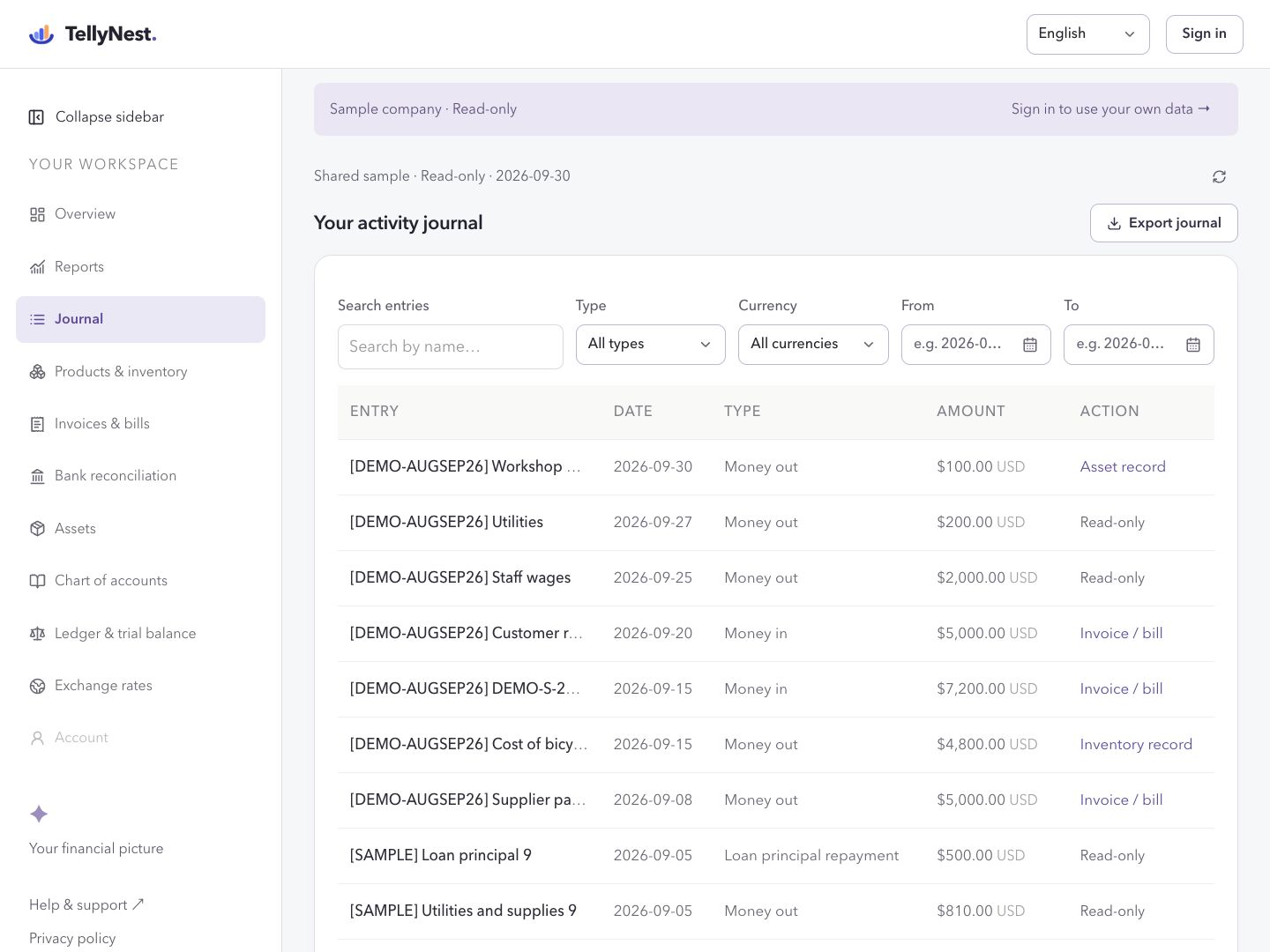
No login needed for the read-only sample. Creating or editing entries requires your own book.
Actual desktop interface · Fictional sample data
01
Find the entries you need
Open Journal and filter by date, transaction type or currency. Check the entries and linked source documents before exporting.
02
Check the trial balance
Open Ledger & trial balance for the same period. Review opening balances, debits, credits and closing balances before handing over the books.
03
Download Excel working papers
Use the journal or trial-balance export button. Chart of accounts, account ledgers, assets and supported reports also have their own exports. Custom statement layouts use browser print or Save as PDF.
Scope of this task
Excel exports are working papers, not signed statutory statements. They are not a full-account backup: report layouts, permissions and all source records are not packaged for one-click re-import.
Before your first real entry
Know where your books live and what you can take with you.
Cloud storage and backups
Records are stored with Supabase in Tokyo, Japan. Signing out does not delete them. The workspace does not offer a full-account backup download or self-service point-in-time restore. Save regular exports; contact support about recovery before relying on it.
Exports you can keep
Download Excel working papers from supported journal, ledger, trial-balance, chart, asset and report screens. Print custom financial statements or save them as PDF. Exports are not a complete restorable copy of the account.
Regions and languages
The workspace supports English and Simplified Chinese, with a functional currency for each book. It provides general small-business bookkeeping, not a country-specific tax or payroll system. Confirm local recordkeeping and data-transfer requirements before using real business records.
What the workflows cover
Bank reconciliation uses uploaded CSV or .xlsx files and user-confirmed matches; there are no automatic bank feeds or money transfers. Inventory tracks serialized units, not a full warehouse or returns system. Tax filing and statutory certification are not included.
 TellyNest